

Lucas Lugarinho at the 16th Gwangju Biennal: first Brazilian Pavilion
Lucas Lugarinho at the 16th Gwangju Biennal: first Brazilian Pavilion
Lucas Lugarinho is one of the artists in the first national pavilion Brazil has ever presented at the Gwangju Biennale in South Korea. Housed in the Gwangju History & Folk Museum and curated by Aldones Nino and Bruna Levi, the pavilion brings together 35 Brazilian artists from different generations and regions of the country.
Ghost Painting VIII and IX
Historically, the technological advances that further enabled the automation of the production of images have, even if unintentionally, also shaped the way physical painting operates and perceives the world. Just like photography could be argued to have unburdened Western painting from its historical duty of capturing and representing a simulacra of reality, how could the complete automation of image-making processes shape the ways and needs of contemporary painting? In this new body of work, Lucas Lugarinho presents pictures that exercises an aesthetic and playful response to generative AI images. In this series of Ghost Paintings, the artist utilizes acrylic medium on retro-reflexive fabric to diffract painting’s shared elements between physical and digital mediums – light, gesture, surface and presence – rearranging them into a game of catch. By obscuring the digitizable photographic gaze necessary to feed generative training models, the artist aspires to evoke the ghastly relevance of attending to physical images in times of accelerated digital media slop.
Within this approach, the works presented at the Brazilian Pavillion at the Gwangju Biennale reflect on liminality as the inherent condition of the gaze of a generation that grew up engulfed by digital screens. Like doomscrolling over our cellphones, AI images have inherited the ethos of contemporary digital image production and consumption: by existing, at its core, as liminal streams of interpolated iterations and assemblages of media.
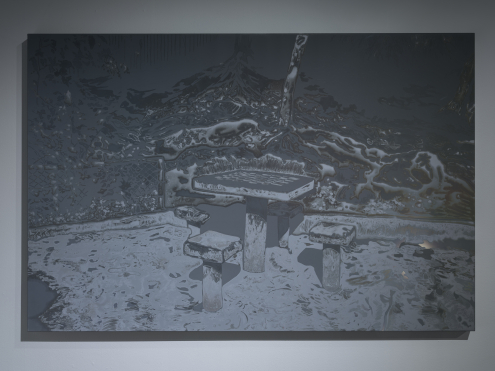
Under such premise, Lugarinho's Ghost Paintings XIII & IX: Game of Life and Olegarinha confronts the state of contemporary images by associating the premise of digital liminality with memory. By depicting locations of the artist's parents neighborhood in Rio de Janeiro – such as a house that is always on sale, and a stone chess table at the end of small square – the artist stages a conflation between the hyper transience of our everyday attention with the mundane liminal spaces that arise from our collective and social memories. The image might be fixed on top of a canvas with brushstrokes and gestures as a preservation of a certain moment, but our experience is dictated by our present relation with it: be it by the current light shining atop of its surface, our angle of view and distance etc. This inflection seems to point to the fact that, as bleak as the landscape of media slop might be, it may as well be the closest our social means of producing images have ever been to the way our own memories operates: liberating ourselves from History while casting us, in exchange, into a state of nostalgia.
Images: Ghost Painting VIII: Game of Life. (2026)acrylic medium, heavy water, colorstream pigment and reflective powder on retro-reflexive fabric120 x 180 cm
Ghost Painting IX: Olegarinha. (2026)acrylic medium, heavy water, and colorstream pigment on retro-reflexive fabric120 x 180 cm
Photos: Vicente de Mello
Things That Devour Tomorrow: Brazil in Germination
16th Gwangju Biennale, 5 September – 15 November 2026
Gwangju History & Folk Museum, Gwangju, South Korea