

Frans Hals Museum acquires video 'Club' by David Haines
Frans Hals Museum acquires video 'Club' by David Haines
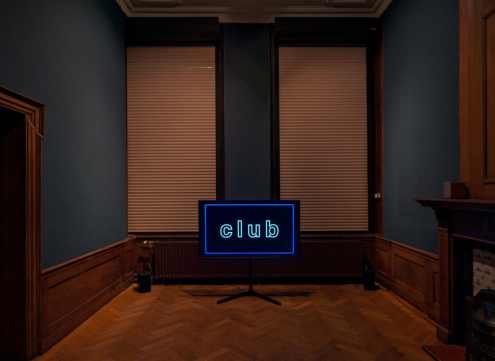
Upstream Gallery proudly announces that the video CLUB (2025) by David Haines is acquired by the Frans Hals Museum.
David Haines’ (1969) work exists at the intersection between the traditional and contemporary (technical) image. Working with a variety of media - from painting and drawing through to music; ceramics and moving image, the work addresses ideas around what it means to make and look at images in our digitally drenched society. Haines works from out of the premise that technique is a language, that the image is both an anthropological and sociological object and that the experience of looking (at art) is essentially spatial, formed out of a symbiotic relationship between material and image.
In this work, CLUB (2025) is not understood as a singular venue or physical location, but as a broader symbolic and affective space—an idea, a construct, and a container for collective memory, desire, and projection. CLUB functions here as a metaphor for queer sanctuary: a site where identity is performed and reimagined, where bodies gather not only to escape but to assert new possibilities of being. The work draws on research from the LGBT Historic Sites archive in New York, intersecting historical documentation with personal reflection.
As the artist states:
Growing up in the 1980s, these spaces represented a vision of freedom for me—an imagined future shaped by sound, movement, and the aesthetics of excess. They offered an intoxicating sense of optimism, of lives fully lived beyond the margins of normative society.” Yet this utopian promise was never without contradiction. The emergence of the HIV/AIDS crisis and the recurrence of violence in queer nightlife spaces—particularly the devastating mass shootings in U.S. gay clubs—exposed the fragility of these sanctuaries. The sense of safety that was once signified became complicated by fear, grief, and ongoing threat. The work draws on a range of images— including daytime television talk shows, police bodycam footage and 1970s archival film—to form an organic, non-linear structure. It reflects on the architecture of the club as otherworldly— spaces designed to suspend reality, existing outside conventional time and social order. In doing so, it considers CLUB as both a refuge and a site of rupture: a space charged with the dual energies of euphoria and anxiety, liberation and vulnerability.