

Unframed Window
Nestor Siré
Unframed Window
Nestor Siré
Amsterdam, 5 Sep - 24 Oct '26
OPENING 5 SEPTEMBER: 17.00 - 19.30 HRS
Upstream Gallery is pleased to announce its first exhibition with Cuban multimedia artist Nestor Siré, currently an artist in residence at the Rijksakademie. His transdisciplinary research examines how technology both shapes and is shaped by social practices, exploring the tension between technological devices and the human uses that appropriate, modify, and reinvent them. This gives rise to informal infrastructures and vernacular forms of innovation.
Images:
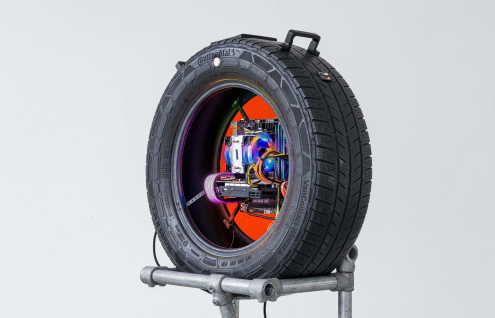
1.PC Gamer [GOMA] by Nestor Siré, 2025
2. Overview Unframed Window by Nestor Siré, 2026
3. Caribbean Enemy, by Nestor Siré, 2026
Unframed Window
The exhibition marks the premiere of a new series of works the artist has recently been developing. Unframed Window is based on a hardware modification technique developed by PC gaming communities, who repurpose discarded LCD monitors into transparent displays. Sire? approaches this DIY technique as a form of vernacular innovation shaped by shared knowledge and informal technological networks, translating it into a sculptural moving image installation.
The series brings together two visual languages that shaped the artist's formation in Cuba: painting, through formal art education, and video games, encountered through the informal, collective gaming culture of the 1990s. Despite their different origins, both became formative in how he came to understand images as constructors of landscapes, bodies, narratives, and cultural identities. Each work establishes a specific visual, autobiographical, or political connection between a painting and a video game. Together, the series becomes a personal exploration of how identity and aesthetics are constructed through images.
Caribbean Enemy connects Wifredo Lam’s La Silla with Contra (Konami, 1987/88), the first shooting game the artist remembers playing as a child in Cuba. The work revisits a childhood memory from an adult perspective, connecting two representations of the Caribbean landscape with geopolitical narratives of invasion, the enemy, liberation, and territorial destruction.
Revolutionary Body pairs a painting from Servando Cabrera Moreno's Los Milicianos series with the video game Guerrilla War (SNK, 1987), originally released in Japan as Guevara before its revolutionary references were erased for Western audiences. It juxtaposes two constructions of revolutionary iconography: the game's masculinised action heroes, and Cabrera Moreno's more sensual, ambiguous militiamen—painted by a gay artist later persecuted by the same revolution he helped visually construct.
Interior Level links Amelia Peláez's Interior con columnas with Super Mario Bros. (Nintendo, 1985), drawing a visual rather than narrative connection between them. Both build their worlds through geometry and colour, the game via the NES's modular tiles and limited palette, Peláez via bold outlines and saturated colour fields that fuse architecture, ornament and Caribbean imagery into a single visual structure.
PC GAMER
Part of the ongoing project CubaCreativa (since 2014)
PC Gamer looks at gaming practices that, through hardware modding, blur the line between innovation and adaptation, exposing the tension between dominant technological models and the collective solutions devised at the margins of hegemonic infrastructures.
PC Gamer [GOMA] Amsterdam houses a modified gaming PC inside a reclaimed car tyre, mounted on a steel frame with an autonomous, battery-powered electrical system. Each work is site-specific, made with locally sourced materials. The piece reflects on technological creativity in a country without an electronics industry, where equipment circulates through informal channels and undergoes multiple life cycles, challenging the colonial hierarchy that recognises innovation only when it originates in hegemonic centres.
But Can It Run Crysis? reworks a familiar gamer-culture meme: the moment an overheating computer emits smoke as a sign of imminent failure. Built from an exposed, modified chassis with Arduino-controlled electronics and a smoke machine, the sculpture holds this collapse in permanent suspension. Smoke here becomes both material and metaphor, part of an archaeology of gamer imaginaries shaped by scarcity, improvisation and desire.